

Top BSc Economics Colleges in India: How to Choose the Right Programme
The top BSc Economics colleges in India differ most in how they admit students, how much quantitative training they teach and what the programme adds beyond the classroom, so the right choice depends on your Class 12 subjects, your goals and the kind of selection process you are ready for. XIM University in Bhubaneswar offers a four-year B.Sc. Economics (Hons.) that is worth adding to your shortlist.
This guide explains what to compare when you shortlist colleges, how admission routes differ across India and how XIM’s programme fits. XIM details come from the university’s own programme and admission pages. Admission details change every year, so confirm the latest on the official pages before you apply.
What is a BSc Economics degree?
BSc Economics is an undergraduate degree that teaches microeconomics, macroeconomics and development alongside a strong dose of mathematics, statistics and econometrics. Many colleges now follow the National Education Policy (NEP) 2020 structure: a three-year degree, with a fourth Honours year that can include a research dissertation.
Compared with a BA in Economics, a BSc usually puts more weight on data work and modelling. The exact mix differs from college to college, so read the semester-wise syllabus before you decide.
What to look for in a BSc Economics college
- Curriculum depth: Does it teach econometrics and statistical software such as R, Python or Stata, or mainly theory?
- Admission route: Is selection by Class 12 marks, an entrance test or an interview? Check the subjects and minimum percentage required.
- Programme length and structure: Three-year or four-year Honours, and whether there are exit options at earlier stages.
- Internships and research: Look for a built-in internship and an option to write a dissertation.
- Total cost: Compare the full cost across all years, including per-semester charges and one-time fees, not just first-year tuition.
- Next steps: Can you continue to an M.Sc., a PhD or a finance and policy career, and does the college say how?
- Published facts: A trustworthy programme page states eligibility, selection and the admission process clearly.
How BSc Economics admissions work in India
There is no single national route. Expect to meet one or more of these:
- Marks-based merit: The college ranks applicants on Class 12 marks, sometimes with extra weight on Mathematics.
- Entrance tests: Some colleges and universities run their own aptitude or entrance tests.
- CUET-UG scores: Central universities and many other institutions admit through CUET-UG, so check whether your target colleges do.
- Interviews: Some colleges select on academic record plus a personal interview.
- Subject requirements: Some colleges require Class 12 Mathematics or Statistics with a minimum score. Others accept any stream.
Whichever route you target, keep a checklist for each college: Class 12 subject requirements, minimum percentage, test and interview dates, application deadlines and documents.
XIM University: B.Sc. Economics (Hons.)
XIM University is a Jesuit university in Bhubaneswar, Odisha, with an NAAC ‘A’ grade. Its B.Sc. Economics (Hons.) is a four-year programme offered by the School of Economics, with 171 credits across eight semesters under NEP 2020.
Curriculum. The first year covers introductory microeconomics, macroeconomics and mathematical methods. The second year moves to intermediate theory and econometrics. In Semester IV, students learn data analysis with statistical software (R, Python, SAS and STATA). Later semesters add public finance, international economics, financial economics, applied quantitative finance and advanced econometrics. The major is Economics with a minor in Applied Econometrics, and Financial Economics is also offered as a minor. More detail is on the School of Economics programme page.
What stands out. A mandatory Summer Internship Programme follows the second year, and students can choose Honours with Research, which includes a 12-credit dissertation in Semester VIII. The degree also has exit points: a certificate after one year, a diploma after two and a bachelor’s degree after three.
Eligibility and selection. Class 12 (or equivalent) in any discipline with at least 60% aggregate. Selection is based on Class 10 and Class 12 performance and a personal interview. The programme page lists no entrance exam. Final-year Class 12 students can apply provisionally.
Fees and scholarships. XIM publishes its current fee structure and scholarship guidelines online. See the UG fee structure and the UG scholarship page for up-to-date details.
Best for: students who want a data-heavy economics degree, do not want to be limited to a particular Class 12 stream, and are comfortable with an interview-based selection.
Which BSc Economics programme should you choose?
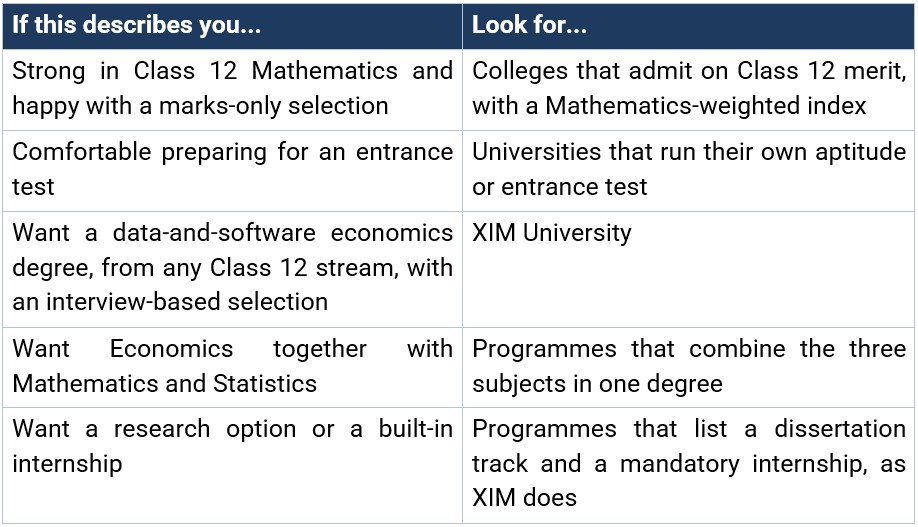
Use the table as a starting point, then read each college’s syllabus and admission notice. A programme with an entrance test you are not ready for may cost you more in the end than one whose selection fits your strengths.
BSc Economics eligibility checklist
The colleges you will see across India show a range of requirements. Minimum Class 12 marks commonly fall between 45% and 70%, depending on the college and category. Some require Mathematics or Statistics, while others accept any stream.
At XIM University, applications for BSc Economics are made online at applyug.xim.edu.in, and the programme page and UG FAQ list the current steps and deadlines.
Careers and further study after BSc Economics
Economics graduates move into analyst roles in finance, data, risk and research, into policy and consulting work, and into further study. Common next steps are an M.Sc. or MA in Economics, an MBA or a PhD. Some graduates prepare for the Indian Economic Service through UPSC or for specialist roles at the Reserve Bank of India.
Skills matter more than the label on the degree. Employers and postgraduate programmes look for econometrics, statistical software and the ability to explain data, which is why the curriculum and internships deserve as much attention as the college’s name.
Mistakes to avoid when choosing a BSc Economics college
- Comparing only first-year tuition and ignoring per-semester charges and one-time fees.
- Missing the Class 12 Mathematics requirement until after you have chosen your subjects.
- Trusting ranking lists that do not say how they were built or when the data was collected.
- Overlooking test dates and application deadlines, which differ from college to college.
- Ignoring what the programme teaches: software, econometrics, internships and research options.
Frequently asked questions about BSc Economics colleges in India
- Which are the top BSc Economics colleges in India?
There is no single ranking that suits every student. The strongest options differ in admission route, quantitative training, internships and research opportunities, so compare them against your own marks, subjects and goals. XIM University in Bhubaneswar is one option to consider, with a four-year B.Sc. Economics (Hons.) that includes econometrics, statistical software, a Summer Internship Programme and a research option.
- Is BSc Economics better than BA Economics?
Neither is better in general. BSc Economics usually leans harder on mathematics, statistics and data work, while BA Economics is often broader. Course content varies by college, so read the syllabus before deciding.
- Is Mathematics compulsory for BSc Economics?
It depends on the college. Some require Class 12 Mathematics or Statistics with a minimum score. XIM University’s admission page asks for Class 12 in any discipline with at least 60% aggregate, though the course itself includes mathematical methods and statistics.
- What is the eligibility for BSc Economics at XIM University?
XIM’s admission page lists Class 12 (or equivalent) in any discipline with at least 60% aggregate marks from a recognised board or university. Final-year Class 12 students can apply provisionally.
- Does XIM University require an entrance exam for BSc Economics?
XIM’s admission page lists selection based on Class 10 and Class 12 academic performance and a personal interview. It does not list an entrance exam for this programme.
- What do you study in BSc Economics at XIM University?
The four-year programme covers microeconomics, macroeconomics, mathematical methods, Indian economy and development economics, data analysis with R, Python, SAS and STATA, public finance, international economics, financial economics, applied quantitative finance and advanced econometrics. The major is Economics, with a minor in Applied Econometrics or Financial Economics.
- Does the BSc Economics programme at XIM include an internship or research option?
Yes. A mandatory Summer Internship Programme follows the second year, and students can choose Honours with Research, which includes a 12-credit dissertation in Semester VIII.
- Can I study BSc Economics after Class 12 Arts or Commerce?
Often yes, but check each college. XIM accepts any discipline, while some colleges require Mathematics or Statistics in Class 12. Always confirm the current requirement on the college’s website.
- How long is a BSc Economics degree?
Some colleges run a three-year degree with an optional fourth Honours year, and others run a four-year Honours programme under NEP 2020. XIM University’s B.Sc. Economics (Hons.) is a four-year programme with exit options after one, two and three years.
- What can I do after a BSc Economics degree?
Common paths include economic, financial, data and risk analyst roles, policy research and consulting, plus further study such as an M.Sc. or MA in Economics, an MBA or a PhD. Some graduates also prepare for the Indian Economic Service through UPSC.
Conclusion
There is no single best BSc Economics college in India, only the best fit for your marks, your subjects and your plans. Shortlist three or four programmes, compare their syllabus, eligibility and admission route, and apply to the ones whose selection process suits you.
If you want a four-year, data-focused economics degree with a built-in internship and a research option, read the full XIM University BSc Economics admission page and the School of Economics programme page.