Top BSc Psychology Colleges in India: How to Choose the Right Programme
The top BSc Psychology colleges in India differ in how they admit students, how much statistics and research training they teach and how much supervised practical work they offer, so the right choice depends on your Class 12 marks, your goals and what you want to do after graduation. XIM University in Bhubaneswar offers a four-year B.Sc. Psychology (Hons.) with two internships and a research option, and is worth adding to your shortlist.
This guide explains what to compare, how admissions work and how XIM’s program fits. XIM details come from the university’s own program and admission pages. Admission details change every year, so confirm the latest on the official pages before you apply.
What is a BSc Psychology degree?
BSc Psychology is an undergraduate degree that studies how people think, feel and behave, using scientific methods. You learn the core areas (cognitive, developmental, social, biological and abnormal psychology) along with statistics and research methods.
Compared with a BA in Psychology, a BSc usually puts more weight on statistics, experiments and the biological side of the subject. The exact mix differs from college to college, so read the semester-wise syllabus before you decide.
What you study in a BSc Psychology programme
- Foundations: general, developmental, cognitive and biological psychology in the first two years.
- Research skills: statistics for psychology, research methodology and experimental work.
- Applied areas: health, community, counselling, educational, organisational and forensic psychology, depending on the college.
- Practical training: practicum, fieldwork and internships, which are where you start to apply what you learn.
What to look for in a BSc Psychology college
- Curriculum depth: Does it teach statistics, research methods and applied areas, or only theory?
- Supervised practice: Look for internships, practicum and community work, and ask who supervises them.
- Admission route: Is selection by marks, an entrance test or an interview? Check the Class 12 requirement.
- Programme length: Three-year or four-year Honours, and whether there is a research dissertation.
- Total cost: Compare the full cost across all years, including per-semester charges and one-time fees.
- Pathway after the degree: Does the college prepare you for a postgraduate course, and does it offer one itself?
How BSc Psychology admissions work in India
Most colleges accept Class 12 from any stream, with minimum marks commonly around 55% to 60%. Routes include:
- Marks-based merit on Class 12 results.
- College entrance tests, sometimes with a skill assessment or presentation.
- Interviews combined with academic record.
- CUET-UG scores at universities that use them.
Keep a checklist for each college: Class 12 requirement, minimum percentage, test and interview dates, application deadline and documents.
XIM University: B.Sc. Psychology (Hons.)
XIM University is a Jesuit university in Bhubaneswar, Odisha. Its B.Sc. Psychology (Hons.) is a four-year, eight-semester programme offered by the School of Liberal Arts under NEP 2020, with internships after Semesters IV and VI.
Curriculum. The first year covers General Psychology, Developmental Psychology, Cognitive Psychology and Bio Psychology, along with communication and community engagement. The second year adds Statistics for Psychology, Research Methodology, Health Psychology and Positive Psychology. The third year moves to Abnormal Psychology, Personality Theories, Social Psychology, Psychological Testing, Neuropsychology and Psychology and Artificial Intelligence. Semester VII covers Counselling Psychology and Psychotherapy, Behaviour Modification, School Psychology and Forensic Psychology.
Research or professional track. In the final semester students choose between a research track with a 12-credit dissertation and a professional-skills track with Organisational Behaviour, Rehabilitation Psychology and Human Resource Management. Minors on the programme page include Cyber Psychology, Community Psychology, Sports Psychology and Qualitative Research Methods.
Practicum. The programme page describes a practicum covering psychological assessment, counselling techniques and community-based mental health services. More detail is on the School of Liberal Arts programme page.
Eligibility and selection. Class 12 (or equivalent) in any discipline with at least 60% aggregate. Selection is based on Class 10 and Class 12 performance and a personal interview. The programme page lists no entrance exam.
Fees and scholarships. XIM publishes its current fee structure and scholarship guidelines online. See the UG fee structure and the UG scholarship page.
Best for: students from any Class 12 stream who want a four-year Honours degree with two internships and a research option, and who are comfortable with an interview-based selection.
Which BSc Psychology programme should you choose?
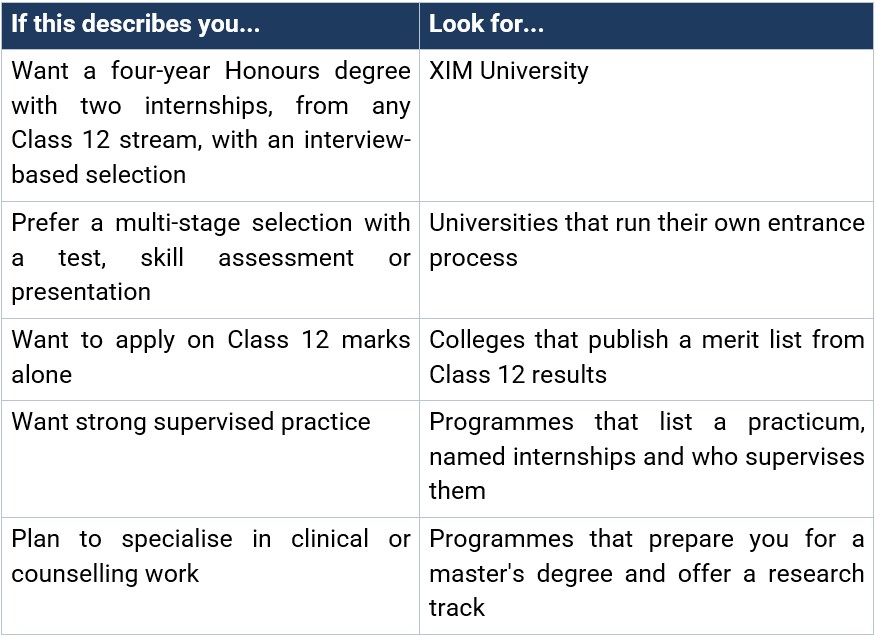
Use the table as a starting point, then read each college’s syllabus and admission notice. A lower cost is not a bargain if the selection route does not fit your strengths or the programme offers little supervised practice.
BSc Psychology eligibility and admission routes
At XIM University, applications for BSc Psychology are made online at applyug.xim.edu.in, and the programme page and UG FAQ list the current steps and dates. Students awaiting Class 12 results can apply provisionally.
Careers and further study after BSc Psychology
A BSc Psychology graduate can work in counselling and wellbeing support, human resources, education, social work, research and community programmes. Many take the degree as a first step towards a postgraduate course, such as an M.Sc. or MA in Psychology, and later a PhD.
If your goal is clinical practice, plan for the long route. In India, clinical psychology generally needs a postgraduate qualification and registration with the Rehabilitation Council of India (RCI), so check the council’s current rules when you choose your master’s course. Skills such as statistics, research writing and supervised practice matter as much as the college’s name, which is why the curriculum and internships deserve a close look.
Mistakes to avoid when choosing a BSc Psychology college
- Choosing from a list that does not say how it was built, when its data was collected or whether the colleges offer a BSc or a BA.
- Comparing only first-year tuition and ignoring per-semester charges and one-time fees.
- Ignoring practical training: ask how many internships there are and who supervises them.
- Overlooking test, interview and application dates, which differ from college to college.
- Forgetting that most clinical and counselling careers need a postgraduate degree.
Frequently asked questions about BSc Psychology colleges in India
- Which are the top BSc Psychology colleges in India?
There is no single ranking that suits every student. The strongest programmes differ in admission route, statistics and research training, and supervised practice, so compare them against your own marks and goals. XIM University in Bhubaneswar is one option to consider, with a four-year B.Sc. Psychology (Hons.) that includes internships after Semesters IV and VI.
- Is BSc Psychology better than BA Psychology?
Neither is better in general. A BSc usually leans more on statistics, research methods and the biological side of psychology, while a BA is often broader and more social-science oriented. Course content varies by college, so read the syllabus before deciding.
- What is the eligibility for BSc Psychology at XIM University?
XIM’s admission page lists Class 12 (or equivalent) in any discipline with at least 60% aggregate marks from a recognised board or university. Students awaiting Class 12 results can apply provisionally.
- Does XIM University require an entrance exam for BSc Psychology?
XIM’s admission page lists selection based on Class 10 and Class 12 academic performance and a personal interview. It does not list an entrance exam for this programme.
- Can I study BSc Psychology without Science or Mathematics in Class 12?
Often yes. XIM University accepts any discipline, and many other colleges accept any stream too. Always confirm the current requirement on the college’s website.
- How long is the BSc Psychology course at XIM University?
It is a four-year Honours programme over eight semesters under NEP 2020. It includes internships after Semesters IV and VI, and students on the research track complete a dissertation in Semester VIII.
- What do you study in BSc Psychology at XIM University?
The programme covers general, developmental, cognitive, biological, abnormal and social psychology, statistics for psychology, research methodology, psychological testing, neuropsychology, counselling and forensic psychology. Minors include Cyber Psychology, Community Psychology, Sports Psychology and Qualitative Research Methods.
- Are there scholarships for BSc Psychology at XIM University?
XIM publishes scholarship guidelines for undergraduate programmes. See the UG scholarship page on the XIM website for the current terms and eligibility.
- What can I do after a BSc Psychology degree?
Common paths include counselling and wellbeing roles, human resources and corporate roles, education and social work, and research. Most students who want a clinical or counselling career continue to a postgraduate degree such as an M.Sc. or MA in Psychology.
- Can I become a clinical psychologist after a BSc in Psychology?
A bachelor’s degree is the first step, not the last. Clinical practice in India generally needs a postgraduate qualification and registration with the Rehabilitation Council of India (RCI), so check the council’s current requirements before choosing your postgraduate course.
Conclusion
There is no single best BSc Psychology college in India, only the best fit for your marks, your goals and your plans. Shortlist three or four programmes, compare their syllabus, eligibility and admission route, and apply to the ones whose selection process suits you.
If you want a four-year Honours degree with two internships and a research option, read the full XIM University BSc Psychology admission page and the School of Liberal Arts programme page.