
There is no single best college for BSc Economics in East India. The right one depends on your Class 12 marks and subjects, the admission route you are ready for and how much data and econometrics training you want in the course. Across West Bengal and Odisha, colleges differ widely in how they select students, so the process often matters as much as the name. XIM University in Bhubaneswar is one option to consider.
This guide explains how admissions work in the region, what to compare and how XIM’s B.Sc. Economics (Hons.) fits. XIM details come from the university’s own pages. Admission rules change every year, so confirm the latest with each college before you apply.
What is a BSc Economics degree?
BSc Economics is an undergraduate degree that combines microeconomics, macroeconomics and development with mathematics, statistics and econometrics. Many colleges now follow the National Education Policy (NEP) 2020 structure of a three-year degree with an optional fourth Honours year, and some offer a four-year Honours programme from the start.
Compared with a BA in Economics, a BSc usually puts more weight on data work and modelling. The mix differs by college, so read the syllabus before you decide.
What to look for in a BSc Economics college in East India
- Admission route: Marks-only merit, a state admission portal, a college entrance test or an interview. This often matters more than the college’s name.
- Mathematics requirement: Several colleges in Kolkata need Class 12 Mathematics with a minimum score; others accept any stream.
- Curriculum depth: Does it teach econometrics and statistical software such as R, Python or Stata, or mainly theory?
- Total cost: Compare the full cost across all years, including per-semester charges and one-time fees.
- Internships and research: Look for a built-in internship and an option to write a dissertation.
- Next steps: Can you continue to an M.Sc. or PhD, and does the college say how?
How BSc Economics admissions differ across East India
- West Bengal: Many colleges select on a merit index built from Class 12 aggregate marks and Mathematics marks, often with a minimum Mathematics score. Many government and aided colleges admit through the state’s centralised portal, WBCAP, and some universities run their own entrance test.
- Odisha: Government and aided colleges admit through SAMS Odisha on Class 12 marks. Private universities, including XIM, run their own admissions.
- Across the region: Minimum Class 12 marks commonly run from about 55% to 70%, depending on the college and category.
Keep a checklist for each college: Class 12 subject requirements, minimum percentage, test and interview dates, deadlines and documents.
XIM University, Bhubaneswar (Odisha): B.Sc. Economics (Hons.)
XIM University is a Jesuit university in Odisha with an NAAC ‘A’ grade. Its B.Sc. Economics (Hons.) is a four-year programme offered by the School of Economics, with 171 credits across eight semesters under NEP 2020.
Curriculum. The first year covers introductory microeconomics, macroeconomics and mathematical methods, followed by Indian economy and development economics. In Semester IV students learn data analysis with statistical software (R, Python, SAS and STATA), and the later semesters add public finance, international economics, financial economics, applied quantitative finance and advanced econometrics. The major is Economics with a minor in Applied Econometrics, and Financial Economics is also offered as a minor.
What stands out. A mandatory Summer Internship Programme follows the second year, and students can choose Honours with Research, which includes a 12-credit dissertation in Semester VIII. More detail is on the School of Economics programme page.
Eligibility and selection. Class 12 (or equivalent) in any discipline with at least 60% aggregate. Selection is based on Class 10 and Class 12 performance and a personal interview. The programme page lists no entrance exam.
Fees and scholarships. XIM publishes its current fee structure and scholarship guidelines online. See the UG fee structure and the UG scholarship page.
Best for: students who want to study in Odisha, are not limited to a particular Class 12 stream, and want a data-heavy economics degree with an internship and a research option.
Which BSc Economics programme in East India should you choose?
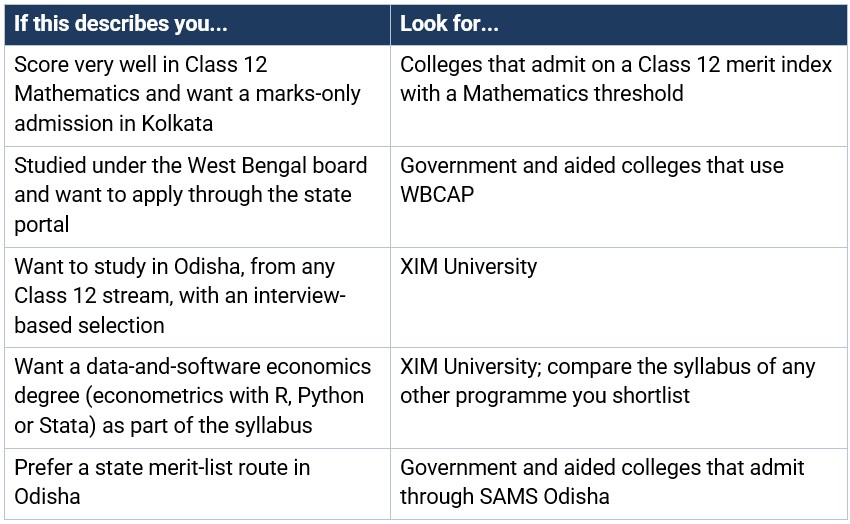
Use the table as a starting point, then read each college’s syllabus and admission notice. Check that you meet the Mathematics requirement and are ready for the selection route, and look for something you can point to in return for a higher cost, such as software training, internships or a research option.
BSc Economics eligibility and admission routes
Routes in the region include college merit indexes, entrance tests, interviews and the state portals WBCAP and SAMS Odisha. Keep a checklist for each college: Class 12 subject requirements, minimum percentage, test and interview dates, deadlines and fees.
At XIM University, applications for BSc Economics shall open soon at applyug.xim.edu.in, and the programme page and UG FAQ list the current steps and dates.
Careers and further study after BSc Economics
Economics graduates move into analyst roles in finance, data, risk and research, into policy and consulting work, and into further study. Common next steps are an M.Sc. or MA in Economics, an MBA or a PhD. Some graduates prepare for the Indian Economic Service through UPSC or for specialist roles at the Reserve Bank of India.
Employers and postgraduate programmes look for econometrics, statistical software and the ability to explain data, so the syllabus and internships deserve as much attention as the college’s name.
Mistakes to avoid when choosing a BSc Economics college
- Picking a college from a list that does not say how it was built, when its data was collected or whether it offers a BSc.
- Comparing only first-year tuition and ignoring per-semester charges and one-time fees.
- Realising late that a college needs 60% in Class 12 Mathematics.
- Missing separate test, interview and state-portal dates.
- Ignoring what the programme teaches: software, econometrics, internships and research options.
Frequently asked questions about BSc Economics colleges in East India
- Which is the best college for BSc Economics in East India?
There is no single best college. The best fit depends on your Class 12 marks and subjects, your budget and whether you prefer a marks-based, test-based or interview-based admission. XIM University in Bhubaneswar is one option to consider, with a four-year B.Sc. Economics (Hons.) that includes econometrics, statistical software and a Summer Internship Programme.
- Which colleges offer BSc Economics in Kolkata?
Several colleges in Kolkata offer BSc Economics, and most set their own Class 12 requirements, often including Mathematics with a minimum score. Check each college’s current admission notice for eligibility, selection and dates.
- Is there a good BSc Economics college in Odisha?
XIM University in Bhubaneswar offers a four-year B.Sc. Economics (Hons.) through its School of Economics. It is a Jesuit university with an NAAC ‘A’ grade, and the programme includes econometrics, statistical software and a Summer Internship Programme.
- What is the eligibility for BSc Economics at XIM University?
XIM’s admission page lists Class 12 (or equivalent) in any discipline with at least 60% aggregate marks from a recognised board or university. Final-year Class 12 students can apply provisionally.
- Is Mathematics compulsory for BSc Economics in East India?
At many colleges in Kolkata, yes, usually with a minimum score. XIM University’s admission page asks for Class 12 in any discipline, although the course itself teaches mathematical methods and statistics.
- How do I get admission to BSc Economics in Kolkata?
It varies by college. Some admit on Class 12 merit through their own processes, some run an entrance test, and many government and aided colleges in West Bengal admit through the state’s centralised portal, WBCAP. Always check the current notification.
- Does XIM University require an entrance exam for BSc Economics?
XIM’s admission page lists selection based on Class 10 and Class 12 academic performance and a personal interview. It does not list an entrance exam for this programme.
- How do admissions work for BSc Economics colleges in Odisha?
Government and aided colleges generally admit through SAMS Odisha on Class 12 marks. Private universities such as XIM run their own admissions. At XIM, selection is based on Class 10 and Class 12 marks and a personal interview.
- Does the BSc Economics programme at XIM include an internship or research option?
Yes. A mandatory Summer Internship Programme follows the second year, and students can choose Honours with Research, which includes a 12-credit dissertation in Semester VIII.
- What can I do after a BSc Economics degree?
Common paths include analyst roles in finance, data, risk and research, policy work and consulting, and further study such as an M.Sc. or MA in Economics, an MBA or a PhD. Some graduates prepare for the Indian Economic Service through UPSC or specialist roles at the Reserve Bank of India.
Conclusion
The best BSc Economics college in East India is the one that fits your marks, your subjects and your plans. Shortlist three or four programmes, compare their syllabus, eligibility and admission route, and apply to the ones whose selection process suits you.
If you want to study in Odisha and are looking for a four-year, data-focused economics degree with an internship and a research option, read the full XIM University BSc Economics admission page and the School of Economics programme page. For a national view, see our guide to the top BSc Economics colleges in India.