Scope of Mass Communication Degree in India 2026: Careers, Jobs and Future Opportunities
The scope of a mass communication degree in India in 2026 extends well beyond newspapers, television and radio. Graduates can build careers in journalism, digital media, content creation, advertising, public relations, social media, corporate communication, OTT and video production, podcasting, events, brand communication and related creative roles. The strongest opportunities increasingly combine communication skills with digital tools, analytics, multimedia production and responsible use of AI.
Why Is the Scope of Mass Communication Expanding in India in 2026?
The Indian media and entertainment industry is becoming more digital, multi-platform and commercially diverse. The FICCI-EY Media & Entertainment report released in March 2026 says India’s M&E sector reached about INR 2.78 trillion in 2025 after growing 9% year on year. Digital media became the largest segment, crossing INR 1 trillion in revenue, while digital advertising grew 26% to INR 947 billion. The report projects the overall sector to reach about INR 3.3 trillion by 2028. This does not mean every media job will grow equally. It does mean the market is creating demand across more channels, formats and business models than the traditional media model alone.
For students, the practical implication is important: a mass communication degree can be valuable when it is treated as a flexible communication-and-media foundation rather than training for only one job title.
Scope of a Mass Communication Degree in India: Major Career Areas
1. Journalism and Digital News
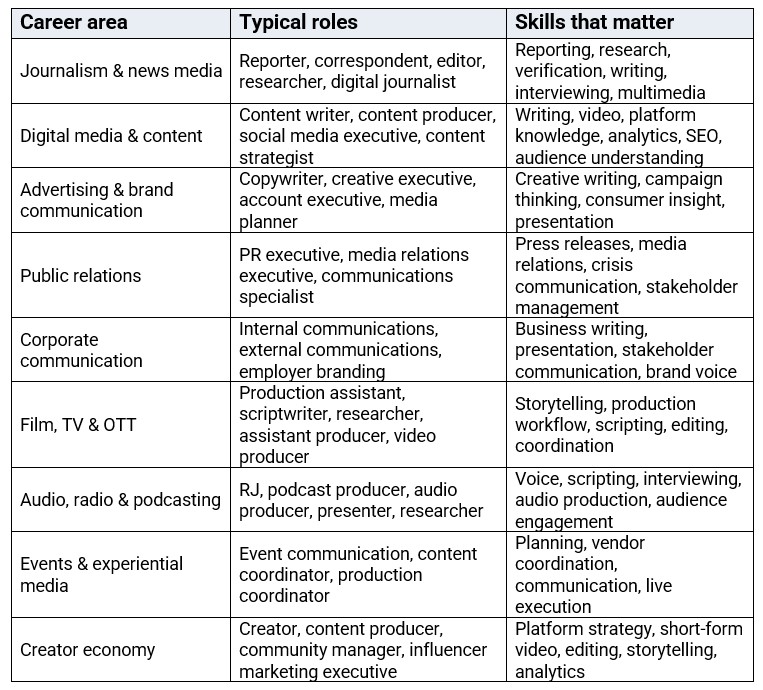
Journalism remains one of the clearest career paths after a mass communication degree, but the newsroom itself has changed. Graduates may work in newspapers, TV, news websites, digital-first publications, news agencies, regional-language media and specialised content teams. Digital news roles increasingly require reporters to work across text, video, images and social platforms rather than produce only written stories.
2. Digital Media and Content Creation
Digital media has become one of the most important growth areas for communication graduates. Brands, publishers, agencies, startups, educational companies and entertainment businesses need people who can research, write, produce, package and distribute content. The job title may be content writer, content producer, social media executive, content strategist, digital editor or multimedia producer.
3.Advertising, Branding and Marketing Communication
Advertising provides opportunities for students who enjoy creative communication but also want exposure to business and consumer behaviour. Career paths include copywriting, creative strategy, account management, media planning, brand communication and campaign execution. Digital advertising has become especially important: FICCI-EY reported that digital advertising represented 63% of total advertising revenues in 2025.
4. Public Relations and Corporate Communication
PR is no longer limited to sending press releases. Organisations need communication professionals who can manage media relationships, executive communication, reputation, crisis messaging, internal communication and digital brand presence. This makes PR and corporate communication useful options for students who are strong in writing, relationship management and strategic thinking.
5. Film, Television, OTT and Video Production
Mass communication graduates can enter production houses, television networks, OTT ecosystems, branded-content studios and independent production environments. Entry-level roles often include research, scripting, production coordination, assistant production and content operations. Practical work with cameras, editing software, storyboarding and production workflows can make a major difference.
6. Podcasting, Radio and Audio Content
Audio has developed into a broader career category through radio, podcasts, branded audio and digital programming. Students interested in voice, interviewing, storytelling and sound production can work as presenters, researchers, producers or audio-content specialists.
7. Social Media and Creator Economy
The growth of social platforms has created roles that did not exist in the same form a decade ago. A communication graduate may work in social media management, influencer marketing, creator partnerships, community management or branded content. Success depends less on simply posting frequently and more on understanding audience behaviour, storytelling, visual formats and performance data.
8. Events and Experiential Communication
The live-events segment is another area worth watching. FICCI-EY reported a 44% rise in the organised live-events segment in 2025, supported by concerts, public events, weddings, government functions and religious gatherings. Communication graduates can find opportunities in event content, public relations, production coordination, audience communication and brand activations.
What Jobs Can You Get After a Mass Communication Degree?
- Journalist / Reporter / Correspondent
- Digital Content Writer or Editor
- Social Media Executive or Manager
- Content Strategist / Content Producer
- Copywriter / Creative Executive
- Public Relations Executive
- Corporate Communication Executive
- Advertising Account Executive
- Media Planner or Media Executive
- Video Producer / Production Assistant
- Scriptwriter / Researcher
- Podcast Producer / Radio Professional
- Event Communication Executive
- Community or Influencer Marketing Executive
Exact job titles vary by employer, city, experience and specialisation. Salary should therefore be treated as a market range rather than a guaranteed outcome. Current career guides from Indeed, Shiksha and other education publishers show broad variation by role and experience, which is consistent with the highly segmented nature of the sector.
Mass Communication Salary in India 2026: What Should Students Expect?
There is no single salary figure for a mass communication graduate because the degree feeds into many different occupations. Entry-level pay can be modest in journalism, production or small agencies, while digital marketing, corporate communication, technology-led content teams and specialised creative roles can offer stronger compensation depending on skills and employer. As experience grows, portfolio quality, specialisation, leadership ability and commercial understanding become increasingly important.
| Factor | Why it affects earning potential |
| Role | Digital strategy, corporate communication, specialised production and some commercial roles may have different pay bands from entry-level reporting. |
| Skills | Writing plus video, analytics, SEO, social platforms, editing or campaign skills can broaden employability. |
| Experience | Portfolio and measurable work outcomes generally matter more as professionals move beyond entry-level roles. |
| Location | Major media and business hubs can have a wider employer base, but remote and digital work can reduce geographic limits for some roles. |
| Specialisation | A clear niche can make a graduate more competitive than a generalist with no demonstrable portfolio. |
Which Skills Will Matter Most for Mass Communication Careers in 2026?
The degree provides the foundation, but employability increasingly depends on what a student can actually create, analyse and communicate. Current 2026 career discussions in the field place increasing emphasis on digital storytelling, platform fluency and the ability to work with new technologies.
- Strong writing, editing and research skills
- Video shooting, editing and short-form content production
- Social media strategy and community understanding
- Basic analytics and performance reporting
- Presentation, interviewing and public speaking
- PR and corporate communication skills
- Content strategy and audience research
- Basic SEO and digital publishing knowledge
- AI-assisted research and content workflows with human fact-checking and editorial judgment
- Media ethics, verification, copyright and responsible communication
How Is AI Changing the Scope of Mass Communication?
AI is changing media work, but it does not remove the need for communication professionals. It changes which tasks are routine and which skills create value. Research assistance, transcription, ideation, basic editing, captioning, translation and content repurposing can increasingly be supported by AI tools. Human judgment is still critical for fact-checking, interviewing, original reporting, storytelling, editorial decisions, reputation-sensitive communication and ethical use of information.
For students, the practical lesson is simple: do not compete with AI at producing generic text. Learn how to use tools to work faster while becoming better at originality, verification, storytelling, communication strategy and multimedia execution.
Is Mass Communication a Good Career Option in India in 2026?
Yes, for students who genuinely enjoy communication, media, storytelling and audience-focused work. The strongest case for the degree in 2026 is its flexibility. A graduate is not locked into one sector; the same foundation can support careers in journalism, advertising, PR, corporate communication, digital media, entertainment and creator-led businesses.
However, the degree is not a substitute for practical experience. Students who graduate with only classroom theory may struggle to compete with candidates who already have portfolios, internships, published work, production samples or campaign experience.
How to Build a Strong Career After a Mass Communication Degree
- Choose a primary direction by the second year: journalism, digital content, advertising, PR, production or another area.
- Build a portfolio while studying instead of waiting for the final semester.
- Complete internships and real projects, including freelance or student-led work where appropriate.
- Learn at least one multimedia production skill such as video editing, audio production, photography or motion graphics.
- Learn basic analytics and digital publishing so you understand how content performs.
- Use AI tools as assistants, not as replacements for fact-checking, originality or editorial judgment.
- Keep your CV, LinkedIn profile and portfolio aligned with the role you are targeting.
- Follow industry changes continuously because media platforms, formats and monetisation models evolve quickly.
Mass Communication vs Journalism: Are They the Same?
They overlap, but they are not identical. Journalism focuses more directly on gathering, verifying and presenting news and information. Mass communication is broader and can include journalism as well as advertising, public relations, corporate communication, broadcasting, digital media, entertainment and audience communication. This broader structure is one reason the degree can support several career routes.
Higher Study Options After Mass Communication
- Master’s degree in Journalism and Mass Communication
- Master’s or postgraduate study in Media Studies or Communication
- Advertising and Brand Management programmes
- Public Relations and Corporate Communication programmes
- Digital Marketing and Strategic Communication programmes
- Film, Television, Production, Screenwriting or related creative programmes
Higher study is not mandatory for every media career. For many entry-level roles, a strong portfolio, internship history and practical skills can matter more than adding another academic credential. The right choice depends on the role and long-term goal.
Frequently Asked Questions
What is the scope of mass communication degree in India in 2026?
The scope is broad and includes journalism, digital media, content creation, advertising, public relations, corporate communication, OTT and video production, radio, podcasting, events and creator-led media. Digital skills increasingly influence employability.
Is mass communication a good career in India in 2026?
It can be a good career for students who enjoy communication, storytelling and media work and who are prepared to build practical digital skills. The degree offers multiple career paths, but outcomes depend heavily on portfolio, internships, specialisation and employer.
What can I do after a mass communication degree?
You can work as a journalist, content writer, editor, social media professional, PR executive, advertising executive, corporate communication professional, producer, scriptwriter, podcast professional or event communication executive, among other roles.
Is mass communication only for journalism?
No. Journalism is one major pathway, but mass communication also covers advertising, public relations, digital media, corporate communication, broadcasting, entertainment, events and other communication functions.
What skills are important after a mass communication degree?
Writing, research, editing, video, social media, analytics, communication strategy, presentation, basic digital publishing and responsible use of AI tools are valuable combinations in 2026.
Does AI reduce jobs in mass communication?
AI is likely to automate or assist some routine tasks, but it also creates new workflows around content production, personalisation, research and media operations. Human skills such as judgment, reporting, interviewing, creative direction and ethical communication remain important.
Can mass communication graduates work in corporate companies?
Yes. Corporate communication, internal communication, employer branding, public relations, content and social media are common corporate pathways for communication graduates.
Which field in mass communication has the most future scope?
There is no single best field for everyone. Digital media, advertising, corporate communication, PR, creator-led content, video and live experiences are notable growth areas, while journalism and traditional broadcasting continue to evolve.
Conclusion
The scope of a mass communication degree in India in 2026 is wider than the traditional image of a reporter, TV anchor or radio professional. India’s expanding digital media ecosystem, advertising market, live-event economy and multi-platform content environment are creating more ways for communication graduates to build careers. The degree is most valuable when combined with practical experience, a focused portfolio and modern digital skills. For students choosing the course today, the goal should not be to prepare for one job title; it should be to become a versatile communication professional who can research, create, distribute, analyse and responsibly improve content across platforms.